


Blog
Memoir vs Autobiography: What’s the Difference? (With Examples)

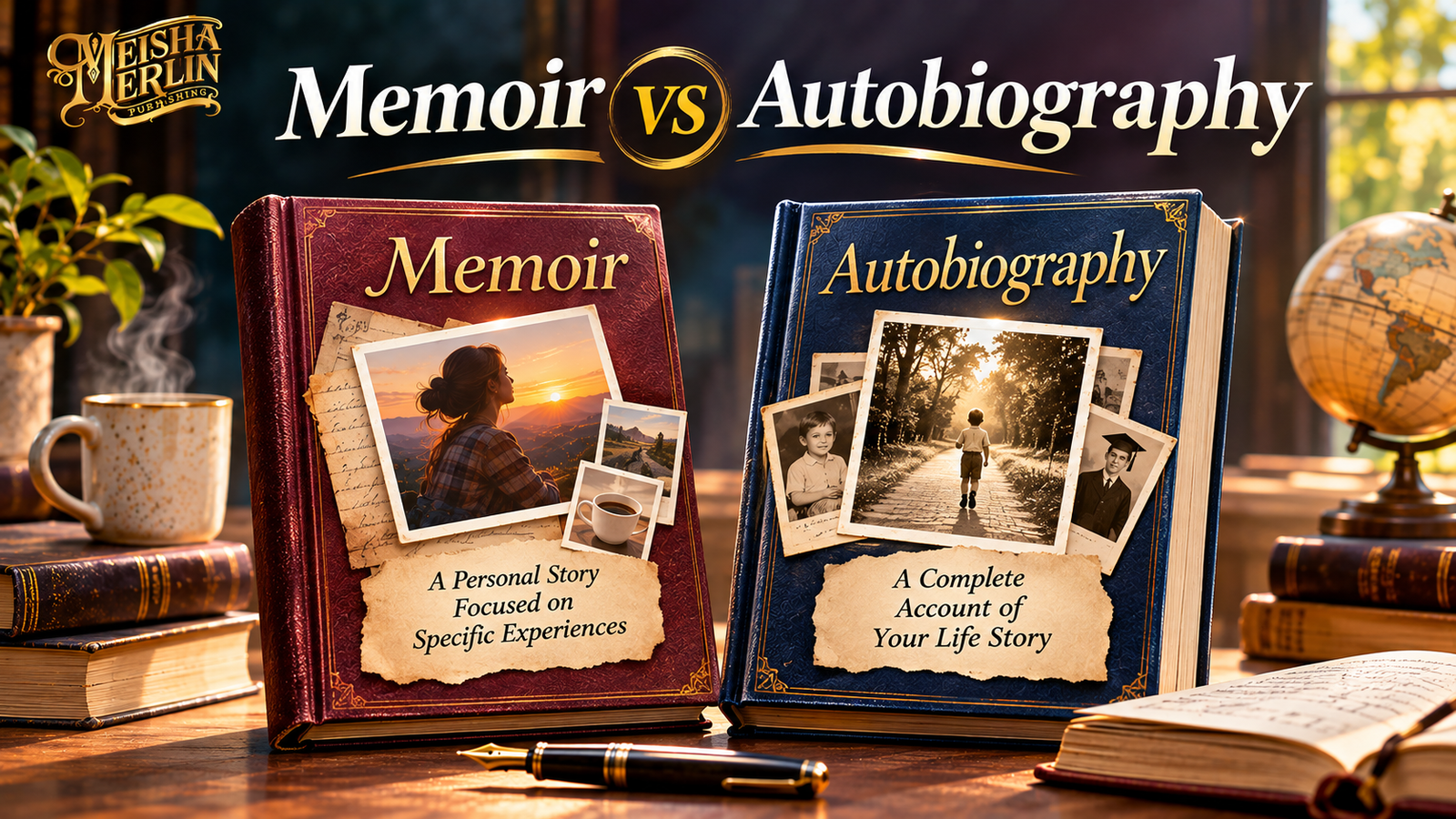
A memoir is a nonfiction account that focuses on a specific theme, period, or experience from someone’s life, built around emotional truth rather than strict chronology. An autobiography covers a person’s entire life from beginning to end in chronological order, with an emphasis on verified facts. Most published memoirs run 70,000–100,000 words, while autobiographies are typically longer and organized around major life stages.
The difference between the two is that a memoir will be more focused on a particular aspect of one’s life or significant experience, while the other will give a more general view of one’s life from childhood until today. Both memoirs and autobiographies will deal with real-life events but told in a different way.
How many times have you found yourself reading someone’s life story and wondered if it’s a memoir or an autobiography? They may look very similar, but there is a clear difference between the two types of non-fiction books that should be understood.
The main reason for the confusion between memoirs and autobiographies is that both books involve people telling their personal stories.
This is what you need to know if you are going to find your next book or even write your own story.
What Is a Memoir?

In simple terms, a memoir is a book that tells personal stories and gives the author’s experience from a certain period of his or her life. A memoir is different from an autobiography in that it covers specific events or relationships, rather than describing all of one’s life journey, starting from childhood till nowadays.
For instance, a person who traveled around the world for many years could tell the story of how those travels influenced his/her personality and changed the author’s worldview. There is no need to mention in such a memoir what school the author attended or where he/she worked.
The idea of a memoir is to make readers not only know what events took place, but also understand the importance of those events for the author.
Memoirs usually have a personal character because of the description of the author’s thoughts and reflections.
“A memoir asks what it felt like. An autobiography asks what happened.”
— Meisha Merlin Publishing
Key Characteristics of a Memoir
There are a few things that most memoirs will have in common:
- Focusing on something specific: The memoir is focused on a specific event or experience.
- Reflection on the experience: The author tells us what they have learned from the experience.
- Connection with the reader: The reader can learn about the emotions and the point of view of the author.
- Non-linear timeline: Things do not have to happen in chronological order.
- True events: The memoir is based on true events and not fiction.
The life of the author does not have to be extraordinary. A memoir could be written about an ordinary life experience.
Examples of Famous Memoirs
There are several popular memoirs that demonstrate how people use their personal experience to create interesting storylines.
1. Educated by Tara Westover
The book tells about the author’s life path from living in isolation in her family to obtaining higher education. It touches upon relations between family members, identity, and knowledge.
2. The Glass Castle by Jeannette Walls
This memoir describes the experiences of the author’s unusual childhood and family conflicts.
3. When Breath Becomes Air by Paul Kalanithi
The book is dedicated to the author’s experiences as a doctor suffering from terminal cancer. It raises questions of the meaning of life, purpose, medicine, and death.
In all the above books, the authors focus on essential experiences and not the events from their lives.
What Is an Autobiography?

An autobiography is a piece of writing by an individual about their life. It is more comprehensive and talks about childhood experiences, education, work experience, successes, and failures. Unlike a memoir, which talks about particular events in one’s life, an autobiography attempts to give the reader a more comprehensive overview of the writer’s life. For instance, an autobiography of a successful businessman could tell the reader about how he/she was brought up, how the person started his/her first business, went through tough times financially, but eventually succeeded. Most autobiographies are written by public figures, politicians, athletes, artists, or people who have had an interesting journey through life. You don’t need to be in the spotlight to write an autobiography.
Key Characteristics of an Autobiography
The following features are characteristic of an autobiography:
- A broad story of life: It encompasses several periods of the author’s life.
- Chronological order: Events go from childhood into the future.
- Significant events: The author reflects on important accomplishments, problems, and choices.
- Personal point of view: The author uses the first person (“I/my”).
- Historical and personal background: The reader understands what the author’s life was like against the backdrop of events and situations that occurred.
Even though autobiographies are usually chronological and not memoirs, emotions and opinions can be reflected in autobiographies.
Examples of Famous Autobiographies
1. The Autobiography of Benjamin Franklin by Benjamin Franklin
Benjamin Franklin describes his early life, personal development, work, and experiences in colonial America.
2. Long Walk to Freedom by Nelson Mandela
Nelson Mandela shares his life story, including his childhood, political involvement, imprisonment, and struggle against apartheid in South Africa.
3. The Story of My Life by Helen Keller
Helen Keller writes about her childhood, education, communication challenges, and experiences growing up with disabilities.
These autobiographies help readers understand the writers’ lives through their personal accounts of important events.
Memoir vs Autobiography: 5 Key Differences

The biggest difference between a memoir and an autobiography is how much of the writer’s life the book covers.
However, there are other differences worth understanding.
Let’s look at these differences more closely.
1. Scope and Focus
Memoir focuses on only one aspect of a person’s life. In this case, for instance, a person who has gone through a terrible accident may choose to write about their experience with rehabilitation, emotional struggles, and lessons learned. In an autobiography, the accident could be just one experience among many other experiences throughout a life story. Put simply, you write a memoir from your life, but an autobiography tells the story of your life.
2. Purpose and Writing Style
Memoirs often seek the underlying meaning of their experiences. The author may spend much time talking about personal development, emotional troubles, or shifts in perspective. On the other hand, autobiographies try to show the author’s experience and life path. It doesn’t mean that an autobiography cannot be emotional or a memoir cannot be informative. They both can merge stories, reflections, and facts. The main difference between them lies in which aspect the author chooses to emphasize.
3. Structure and Timeline
Many autobiographies use a chronological structure. An author may start with their childhood, continue with their adolescence, proceed to their adult life, and end with their latest experiences. The structure in memoirs is different. For example, a memoir may start with an exciting incident, flashback to the past, and then continue from there. Thus, memoir writers can organize their experiences according to the message they want to convey to their readers.
4. Facts, Memories, and Personal Reflection
Both memoirs and autobiographies are non-fiction, which implies that they should depict true events. Nevertheless, memories aren’t always accurate. Memoirists tend to depend heavily on personal memories, feelings, and interpretation. They can recall how the event influenced them. Autobiography writers can refer to personal documentation, letters, pictures, journals, historical papers, and other sources to reconstruct events. Both genres can be aided by research and fact-checking. Writers shouldn’t make up significant events or conversations as precise historical facts.
“Facts make a life verifiable. Feeling makes it worth reading.”
— Meisha Merlin Publishing
5. Reader Experience
Why do people read memoirs? They usually read them because they would like to know more about another person’s experience. It can be a story about how the person overcame his/her challenges, found the purpose of life, developed in terms of relationships, and underwent a personal change. In turn, autobiographies are usually preferred by those people who would like to know the whole story of another individual. An example is a person who would like to know more about the life of some historical figure and therefore prefers autobiography.
What Are the Similarities Between a Memoir and an Autobiography?

While there exist many differences between a memoir and an autobiography, some similarities cannot be overlooked. First of all, both memoir and autobiography belong to the genre of nonfiction. The stories of a memoir or an autobiography reflect real people and their real experiences. Secondly, both memoir and autobiography are written in the first person. People read what the author experienced. Thirdly, both memoir and autobiography might contain reflections, feelings, relationships, as well as important lessons of life for the writer. Lastly, memoirs and autobiographies give authors an opportunity to keep their memories and share experiences with future generations.
Memoir vs Autobiography vs Biography: How Are They Different?

Another form of life writing that is frequently mistaken for memoirs and autobiographies is biography. Biography is a form of narrative that relates to somebody else’s life story. For instance, when you write about your own childhood and work experience, you would be writing an autobiography. When a researcher investigates your life and writes about it in a book, you have a biography. Writing just about the five years you have spent developing your business and changing through your experience may be a memoir.
The distinction can be made in the following way:
Understanding memoir vs autobiography vs biography makes it easier to identify different types of nonfiction books.
How to Decide Whether to Write a Memoir or an Autobiography

In case you have the urge to write an autobiography, you may ask yourself which type is suitable for you. It will depend on what the reader should know and how much of your life you wish to reveal.
Ask yourself the following question first of all:
Do I want to cover my whole life story or just one particular experience?
When Should You Choose a Memoir?
In such instances, memoir might serve as an ideal genre to choose.
For instance, you can write about:
- Growing up in a unique environment
- Conquering some obstacle
- Migrating to another state
- Developing a unique bond
- Finding a purpose for your existence
- Getting valuable insights from your work or travel experiences
You don’t need to give every single detail of your life. All you need is to highlight those aspects that will reinforce the central message of yours. Memoir writing is particularly effective if you would like to evoke emotional responses from the reader.
When Should You Choose an Autobiography?
The use of an autobiography could be better when documenting various stages in your life. You may be interested in describing how your childhood affected your career, the problems you have faced during your life, and how all this made you the person that you are now. Autobiography may be used for preserving your family history and significant events in your personal life.
Choose an autobiography when you want to describe several stages of your life rather than focusing on one particular experience. Once you have decided which format suits your story, you can begin planning how to bring your book to readers. If you are considering publishing independently, our guide on how to self-publish a book explains the main steps involved in preparing and publishing your manuscript.
Tips for Writing a Memoir or Autobiography

Putting pen to paper when writing about your life can be intimidating. You may have many years’ worth of memories and stories to tell and may not know where to start. Fortunately, you do not need to write everything at once. Starting with a clear structure and developing your ideas gradually can make the process easier. Once your manuscript is complete, professional book editing services can help improve its clarity, structure, consistency, and readability before publication.
How to Start Writing a Memoir
How to Start Writing an Autobiography
Can a Professional Ghostwriter Help You Write a Memoir or Autobiography?

You may have many years’ worth of stories that you would like to share but find it difficult to put them into words. This is where a professional ghostwriter can help. A ghostwriter can work with you to capture your experiences, organize your memories, and develop them into a well-structured book that reflects your voice and perspective. If you want professional assistance with telling your life story, our memoir ghostwriting services can help turn your personal experiences into a complete manuscript.
Whether you are writing about one meaningful experience or documenting your entire life, professional assistance can help you develop your story into a finished book. At Meisha Merlin Publishing, we support authors through different stages of the process, including ghostwriting, editing, and book publishing services. From developing your manuscript to preparing it for publication, our services can help you move forward with your book project.
“Your life doesn’t have to be famous to be worth writing — it has to be true.”
— Meisha Merlin Publishing
Ready to Turn Your Life Story Into a Book?
Your experiences deserve to be told in your own voice. Whether you’re planning a memoir or autobiography, Meisha Merlin Publishing can help you take the next step.
Not Sure Which One Fits Your Story?
Whether it’s a memoir or a full autobiography, Meisha Merlin Publishing can help you shape your story and bring it to readers — from writing support to editing and publishing.